
How to stabilise a production team when workforce demand fluctuates
Production volume changes faster than staffing capacity. Learn which part of the team to keep stable, when overtime stops being a reserve and when flexible external capacity makes sense.
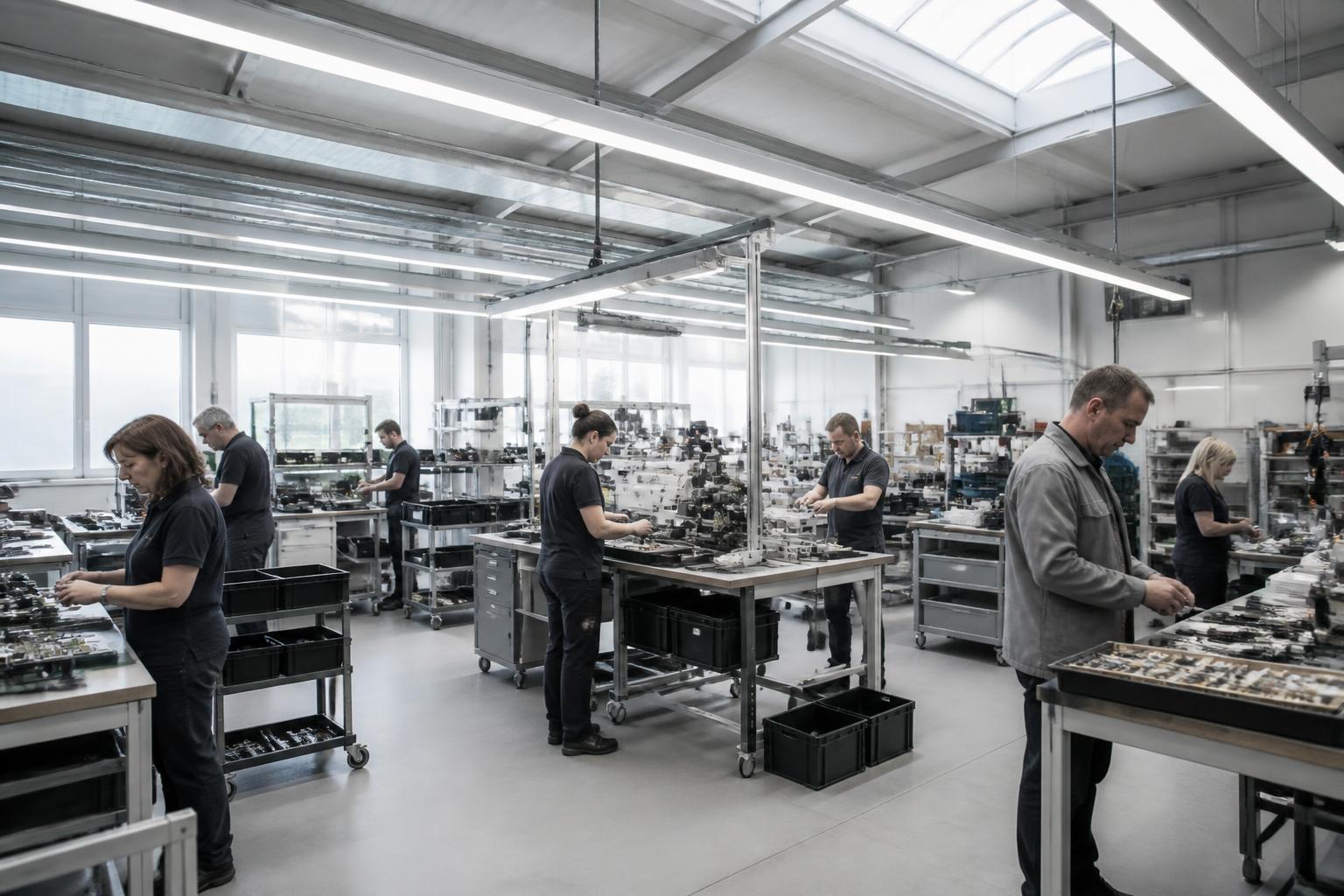
When the production plan changes faster than staffing capacity
A manufacturing company can have a stable team today and face a completely different situation a few weeks later. A new project arrives, a customer increases an order, another line starts up or part of the production is transferred from another plant. The need for workers suddenly grows by ten, twenty or more people.
A few months later the situation may be the opposite. The project ends, orders return to their original level or the production mix changes.
For manufacturing this is a normal development. For staffing capacity, however, it is a demanding task. People cannot be switched on and off according to the production plan, and a good worker does not appear on the day the company needs one.
That is exactly why recruitment alone is not enough. A company needs to know which part of its capacity it wants to keep stable and how it will react to periods when the need for workers rises or falls.
Fluctuating workforce demand does not mean poor planning
Changes in production volume are a natural part of industry. Some companies work with seasonality, others with project-based production or customer orders that can change at short notice.
The problem is not the fluctuation itself. It arises when the company starts from scratch every time demand increases: it hastily opens recruitment, asks existing people for overtime and moves workers between workstations.
Such a model can handle one peak. When it repeats regularly, however, it creates pressure on production, HR and shift supervisors alike.
A stable internal core is the foundation
When the need for workers fluctuates, a stable internal core matters a great deal. It consists of people who know the production, the work standards and the quality requirements, and who can cover key positions.
Such a team carries the know-how and the continuity of the operation. It is therefore risky to respond to every drop in orders by reducing the number of experienced people and then looking for them on the market again when growth returns.
So the question is not only: how many workers do we need today? The more important question is: which capacity do we need to protect even in periods of lower volume so that we can handle the next growth without chaos?
Not every capacity needs the same degree of flexibility
Critical workstations, technical positions and people with a long adaptation time require a different staffing strategy than simpler operations for which a worker can be prepared considerably faster.
A manufacturing company can therefore divide its capacity according to how difficult it is to replace and how quickly the need for it changes.
When overtime stops being a reasonable reserve
The first reaction to short-term growth in production is often overtime. For a one-off need it can be the fastest solution.
If the increased volume lasts several weeks or months, however, overtime can turn from a temporary tool into a regular part of staffing capacity.
Repeated overtime burdens the reliable workers above all, increases fatigue and, over a longer period, can encourage absences or departures.
Rapidly hiring a large number of people has its limits
Another natural reaction is intensive recruitment. The company needs, for example, twenty new operators and wants to get them into production as soon as possible.
The number of new starters alone, however, does not yet create capacity. New people need documentation, work equipment, training, mentors, workstations and time to adapt.
For a larger ramp-up it is therefore necessary to plan not only the start date, but also who will train the people, which shifts they will be assigned to and when independent work is expected of them.
Flexible capacity does not mean an unstable team
The term flexibility is sometimes associated with a constant rotation of people. For manufacturing, such a model is often counterproductive.
Genuinely flexible capacity should be able to react to a change in volume while preserving as much stability as possible among the people who already know the operation.
If the external team changes every week, the shift supervisor repeatedly deals with training, errors and uneven performance. Formally the company is adding headcount, but at the same time it is creating an additional operational burden.
That is why in industrial staffing it is not only the number of people supplied that matters, but also their stability, attendance, coordination and ability to remain part of the production team for as long as the company needs them.
From practical experience
During a project ramp-up, all the attention often focuses on the deadline: by a specific date we need a certain number of workers. That is understandable, because without people production will not start.
The decisive question, however, comes a few weeks later. How many of the people hired have stayed, how many already work independently and how much time does their coordination still consume?
Thirty new starters and a stable team of thirty people are not the same result.
When an external staffing model makes sense
External capacity can be suitable where a company needs to handle a time-limited project, a seasonal peak, the ramp-up of new production or a period in which it does not yet know whether the increased demand will be long term.
It also makes sense when a company wants to protect its stable internal core and cover the more flexible part of its demand without constant recruitment and subsequent headcount reductions.
The decision, however, should not rest on the hourly rate alone. It is important to know who bears responsibility for recruitment, attendance, coordination, replacements, administration and the stability of the team.
FLEXIVIO as a partner for flexible manufacturing capacity
At FLEXIVIO we see industrial staffing as part of an operational solution, not merely as one-off recruitment.
The goal is to create a stable team that knows the workplace and can support production during a period of increased demand. Such a model includes the preparation of workers, coordination, handling of absences and ongoing communication with the client.
An external team should bring the company flexibility. It should not create another everyday staffing problem.
And what if the need for workers drops again?
Flexibility has to work in both directions. Just as a company needs to be able to increase capacity, it should also have the conditions for reducing it agreed in advance.
With project-based or seasonal demand it is therefore important to talk from the very beginning about the expected duration, the minimum volumes and the way the external team will be gradually ended or reduced.
Transparent rules protect production, the partner and the workers themselves from last-minute decisions.
A practical capacity model
- a stable core for critical competencies and long-term production,
- interchangeable internal capacity for ordinary fluctuations,
- flexible capacity for seasonal, project-based or temporary increases in production.
What to expect from an industrial staffing partner
- to understand the required volume and the ramp-up date,
- to know the job profiles and the conditions of the operation,
- to have a clear way of selecting and preparing workers,
- to be able to handle replacements and absences,
- to ensure coordination after the start date,
- to monitor the stability and attendance of the team regularly,
- to be able to increase or reduce capacity as agreed.
How to prepare for growing demand before it happens
- define the minimum stable internal core,
- identify the positions that can be topped up flexibly,
- know the adaptation time of individual workstations,
- prepare the capacity of mentors and shift supervisors for a larger ramp-up,
- set the point at which overtime is no longer enough,
- agree in advance how external capacity will be increased.
What you can do today
- In which periods did you have the greatest shortage of people?
- How much overtime arose during those periods?
- How long did it take before a new worker reached independent performance?
- Which positions do you need to keep stable regardless of production volume?
- Which workstations can be topped up more flexibly when orders increase?
- How many people from larger recruitment waves stayed after the first and the third month?
- Do you have a scenario ready if the need for workers grows by 10, 20 or 30 percent within a few weeks?
Conclusion
A manufacturing company does not need the same number of workers throughout the year. It does, however, need a stable way of reacting to a change in volume.
Key competencies and know-how should remain protected in a stable core. The more flexible part of capacity can respond to projects, seasonality and fluctuations in orders.
Flexibility should not mean a constant exchange of workers. It should mean the ability to adjust capacity without losing the stability of production.
Flexibility should not mean a constant exchange of workers. It should mean the ability to adjust capacity without losing the stability of production.
What we recommend reading next
Overtime in manufacturing: when it helps and when it signals badly set capacityOvertime in manufacturing: When it helps and when it signals badly set capacity8 min readHow to plan shifts in manufacturing and handle unexpected worker absencesHow to plan shifts in manufacturing correctly and handle unexpected worker outages7 min readCross-training in manufacturing: why it is dangerous when only one person can run a critical workstationInterchangeability in manufacturing: Why it is dangerous when only one person can run a critical workstation8 min readOnboarding in manufacturing: why the first days decide whether a new employee staysOnboarding in Manufacturing: Why the First Days Decide Whether a New Employee Stays6 min readQuestions about this topic? See the Knowledge Centre FAQ.
Related topics
- Workforce planning
- Workforce management
- Overtime management
- Cross-training and interchangeability
- Onboarding
- Cost management