
From 7 forklift drivers to a workforce partnership: how trust is built in manufacturing
The cooperation did not begin with a large contract, but with approximately seven forklift drivers. After more than eight years of continuity it covers recruitment, selection, preparation and induction of workers.
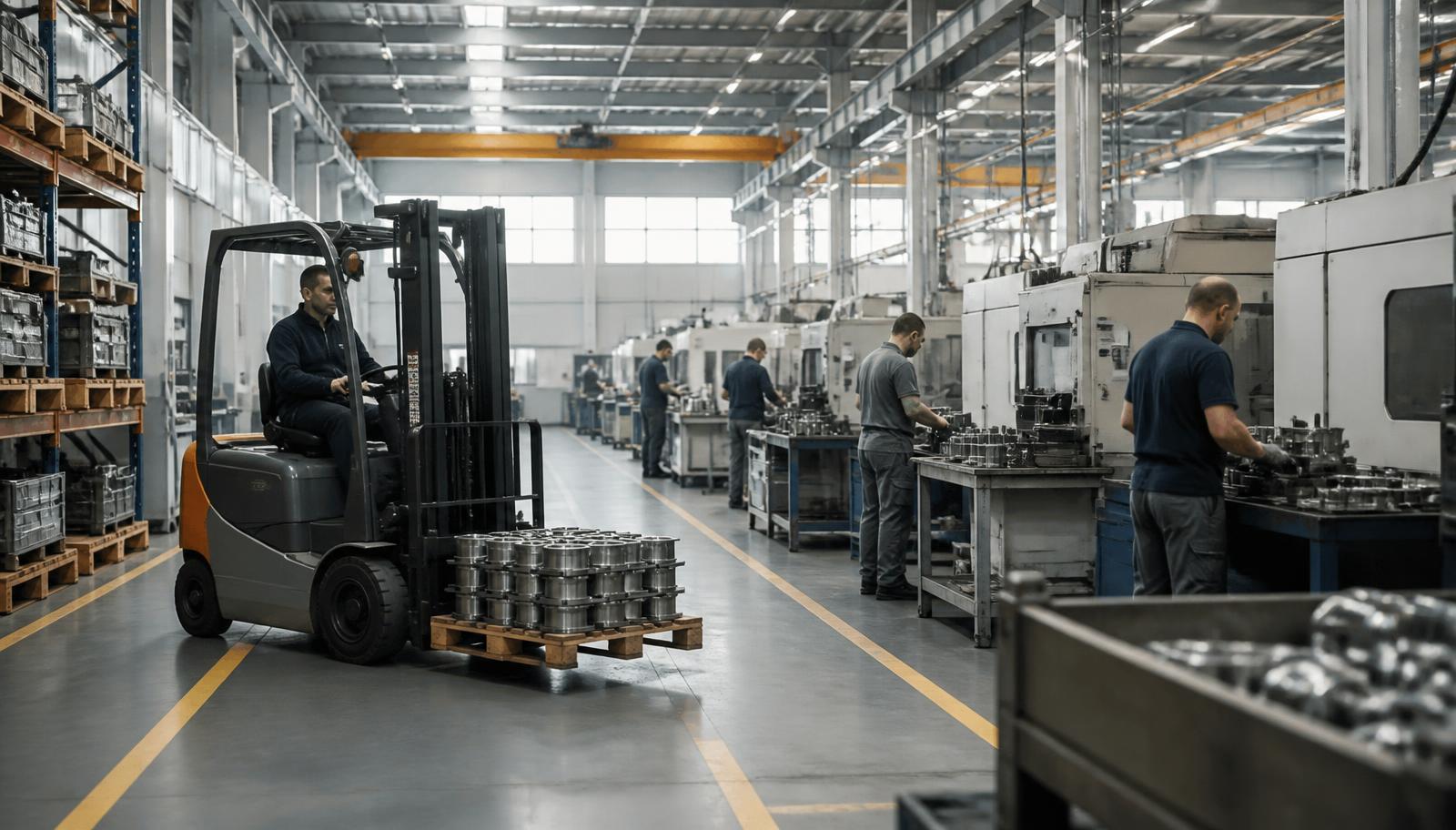
Client: an anonymised engineering company in the Žilina region
Note: The partnership began more than eight years ago under a predecessor company. After FLEXIVIO was established, the cooperation continued under the new brand and organisational model.
The partnership did not start with a big contract
At the beginning this was not a comprehensive workforce project, nor did it involve dozens of workers. The client was solving a specific operational problem: it could not secure the required number of qualified forklift drivers.
The first assignment was therefore clear. Add seven forklift drivers to the team and make sure they were genuinely usable for the production operation – not merely hired on paper.
It is precisely on assignments of this size that the quality of a partner often shows best. The client does not need a presentation about future cooperation. It needs people to start, to handle the required work, and the supplier to be able to deal with day-to-day operational matters.
The starting situation
The engineering company had its own production and logistics processes, but the available staffing capacity of forklift drivers did not cover the required needs of the operation.
The problem was not that there was not a single suitable candidate on the market. The challenge was getting the required number of people into the operation, selecting workers able to handle the required activity and keeping the team sufficiently stable.
When a forklift driver is missing in manufacturing, it is not just an empty slot in the attendance sheet. Material has to reach the workstation, finished production has to be moved and internal logistics has to keep pace with the production process. A shortage of people in one support position can therefore affect more than logistics itself.
The first assignment: seven forklift drivers
The cooperation began with approximately seven forklift drivers. The goal was not to create a large external team, but to solve a specific capacity need of the client.
We focused on selecting suitable workers, their readiness for the required activity and their subsequent stability after starting.
The number of workers gradually increased to approximately fifteen forklift drivers. The expansion did not come because a large project had been agreed at the outset. It came only after the first part of the cooperation worked in practice.
From supplying people to growing trust
It is easier for a client to expand cooperation with a partner it already knows in a real operation. It knows how the partner communicates, how it reacts when someone is missing and whether it can be relied on after the workers have started.
It was precisely this everyday performance that gradually opened space for further assignments. From the original need for forklift drivers, the cooperation began to expand to production positions as well.
At first this involved a smaller number of workers. With growing trust and the client's needs, the scope gradually increased to approximately 30 to 40 workers.
Expansion to production positions
A production position brings different requirements than internal logistics. It is not enough to find a person who can start. It is necessary to select a worker suitable for the specific working environment, prepare them for the required activity and manage the period until they become a stable part of the process.
As the cooperation expanded, our role changed as well. From originally securing a specific group of workers, a broader workforce model gradually took shape.
What the workforce model covers today
Within the cooperation we routinely take care of the entire process before a worker is handed over to the production process.
- recruitment of suitable candidates,
- selection of workers according to the requirements of the workplace,
- preparation and training,
- induction of workers,
- monitoring their readiness for independent work,
- the subsequent handover of a prepared worker into the production process.
This moves part of the staffing workload outside the client. Production does not receive only the name of a person who is due to start, but a worker who has gone through a defined preparation process.
Why the difference between a start date and a prepared worker matters
In high-volume recruitment it can be tempting to measure success by the number of start dates. For manufacturing, however, it matters more how many people stay, get through adaptation and are able to join the real process.
A worker who signs the documents and starts on the first day does not yet necessarily represent full production capacity. They need to know the workplace, the rules, the work procedure and the expectations.
That is why, as the cooperation expanded, we placed emphasis not only on recruitment, but also on selection, preparation and induction.
From approximately 7 to 30–40 workers
The scope of the cooperation changed significantly over the years. We started with approximately seven forklift drivers. Their number later grew to approximately fifteen and the cooperation subsequently expanded to production positions as well.
In the broader model the number of workers moved at a level of approximately 30 to 40 people.
These numbers are not presented as a one-off recruitment record. What matters more is what they show about how the relationship developed: the client gradually entrusted a larger part of its staffing responsibility to the partner.
More than eight years of continuity
The partnership with the client began more than eight years ago under a predecessor company. After FLEXIVIO was established, the cooperation continued under the new brand and organisational model.
We consider this continuity more important than a short-term volume of workers. Long-term cooperation in manufacturing cannot be sustained by the first successful recruitment alone. Every further month brings absences, changes in need, new positions, arrivals, departures and situations that have to be resolved as they arise.
From a practical point of view
A large workforce partnership does not have to start with a large project. In this case it started with seven forklift drivers and a clearly defined need.
The scope of the cooperation grew only after the client saw the result in day-to-day operations. First further forklift drivers were added, later production positions and finally broader responsibility for the recruitment, selection, preparation and induction of workers.
The strategic partnership was not created by signing a large contract. It came about gradually, because each further entrusted responsibility was built on the trust earned with the previous one.
What changed for the client
The goal of the cooperation was not to replace the client's internal management of production. The value came from the fact that the client did not have to start the entire staffing process from scratch every time the need grew.
Gradually it gained a partner that knew the environment, the requirements of the workplaces and the way workers have to be prepared before they are placed into the production process.
- an increase in available staffing capacity,
- one partner for several types of work positions,
- recruitment and selection of workers according to the client's requirements,
- preparation and induction before full placement into production,
- continuity of cooperation even when the scope of the need changes.
What decided the expansion of the cooperation
In a long-term workforce partnership, the ability to find a candidate is not the only decisive factor. The client needs to know that the partner will remain functional after the first day of the start as well.
Trust is built in ordinary situations: when capacity has to be topped up, when a new person needs more support, when the required number of workers changes or when the cooperation expands to another position.
It was precisely the ability to handle these situations that gradually allowed an originally narrowly defined service to expand into a broader workforce partnership.
What another manufacturing company can take away from this project
A manufacturing company does not have to entrust a large scope of responsibility to an external partner from day one. In many cases it is more sensible to start with a clearly defined area and test the partner in a real operation.
- start with the specific problem you need to solve,
- evaluate not only the number of start dates, but also the stability and readiness of people,
- watch how the partner communicates and resolves operational situations,
- expand the cooperation only once the first model works,
- with a larger scope, set clear competencies and responsibilities for both sides.
The best proof of a partnership is the growth of entrusted responsibility
At the time of the first assignment the client does not yet know how the cooperation will work in five or eight years. It only knows whether the partner managed to fulfil today's task.
If one group of forklift drivers gradually becomes a broader workforce model, this is not only growth in the number of workers. It is the result of trust that had to be confirmed in practice again and again.
The best proof of the quality of a workforce partner is not the size of the first order. It is the scope of responsibility the client is willing to entrust to it later.
About the anonymisation
This case study is based on real long-term cooperation in the engineering industry in the Žilina region. The identity of the client and some operational details are not disclosed for reasons of commercial confidentiality. The stated numbers of workers are approximate and describe the real development of the scope of the cooperation.
Related topics
- Workforce partnership
- Workforce management
- Workforce planning
- Onboarding
- Outsourcing