
Overtime in manufacturing: When it helps and when it signals badly set capacity
Overtime is not the problem. The problem starts when a temporary fix becomes part of the ordinary production plan.
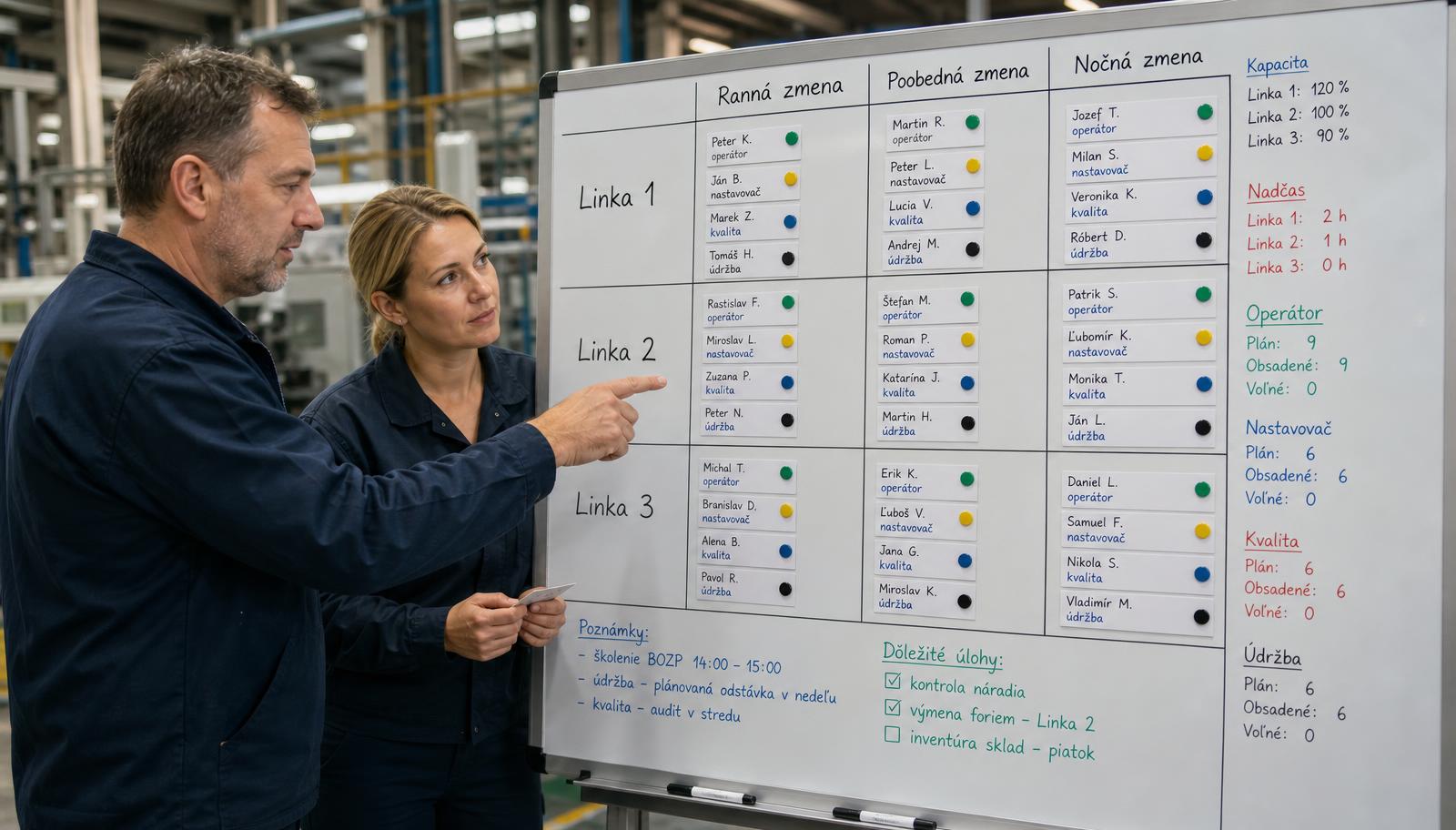
When overtime saves the production plan
Friday afternoon. Production needs to finish an order that has to leave for the customer on Monday morning. A technical stoppage occurred during the week and part of the planned volume was not produced. The shift supervisor agrees a Saturday shift with the team and the missing volume is completed.
In a situation like this, overtime did its job. It helped the company handle a short-term deviation without putting the delivery date at risk.
The problem begins elsewhere. The Saturday repeats a week later. Then again. Overtime no longer serves to handle an exceptional situation; it gradually becomes the way the company tops up the capacity it lacks during ordinary working hours.
The problem arises when a temporary fix becomes part of the ordinary production plan.
Not every hour of overtime means the company plans badly
Manufacturing never operates in completely stable conditions. An unexpected order, a technical stoppage, a delayed material delivery or a sudden increase in customer demand can all occur. Short-term overtime can be a rational and economically sound answer in such situations.
The number of overtime hours alone is therefore not enough to judge whether a company has a problem. Their repetition, their cause and which workers actually work them say far more.
Three situations that must be told apart
1. Overtime as a response to an exceptional event
A technical failure, an unexpected order or a short-term loss of capacity can create a need for extra work. If the situation does not repeat and the team returns to its normal regime once it is handled, overtime is fulfilling its natural function.
2. Repeated overtime caused by a shortage of workers
A different situation arises when overtime appears every week or every month for the same reason. People are missing, workstations are not sufficiently interchangeable, or planned capacity is persistently lower than the required output. At that point overtime is no longer solving a random event. It is covering up a capacity problem.
3. Overtime built into the production plan
The riskiest state occurs when a company, while drawing up the plan, automatically assumes that a certain part of the volume will be completed through overtime or weekend shifts. Such a plan may work in the short term. It is, however, dependent on people's willingness to work extra on a regular basis. If part of the team falls ill, refuses another Saturday or leaves the company, the planned capacity can fall apart very quickly.
Why the same people so often work the overtime
When a problem arises, the shift supervisor naturally turns to the workers they can rely on. They know the workstation, they deliver the required output and they can operate without lengthy training. In the short term this is the simplest solution. If it repeats, however, the most reliable people begin to carry a greater share of the load than the rest of the team. This is where a quiet paradox appears: the company solves a shortage of capacity by putting even more strain on the workers it most needs to keep.
A chain reaction that can start very quickly
Repeated overtime does not only create higher wage costs. Used over the long term, it can trigger a chain of further operational problems.
- greater worker fatigue,
- lower willingness to accept further overtime,
- a rise in short-term absences,
- more pressure on the remaining workers,
- a higher risk of errors and falling output,
- dissatisfaction among the most heavily loaded people,
- departures of experienced workers,
- a further reduction in available capacity.
The company can then end up in a circle in which a shortage of people creates overtime and overtime gradually worsens the problem of people being available.
Unreported absences in manufacturingUnreported absences in manufacturing: How they affect the production plan and what a company can do5 min readFrom a practical point of view
A Saturday shift on its own says nothing about the quality of production management. It is far more important to know why it was needed.
If production is catching up on a one-off technical stoppage, the reason is clear. If, however, the Saturdays repeat because three operators have been missing from the workstation for a long time, that is an entirely different situation.
The same applies to daily overtime. Thirty or sixty extra minutes may seem negligible. But if the same team works them several times a week for months, the company is in fact already using overtime as regular production capacity.
Overtime should be assessed by its cause and its repetition, not only by the number of hours worked.
What does overtime really cost?
When overtime is evaluated, attention usually goes to the wage premium. The real economic impact can be broader.
The decision involves direct wage costs, statutory premiums, any transport or catering costs, but also the less visible consequences of long-term overload. If repeated overtime increases absences or accelerates the departure of an experienced worker, the costs are no longer limited to a single weekend shift.
It therefore makes sense to compare the long-term price of regular overtime with the price of stable capacity. Sometimes overtime is cheaper and correct. At other times a company pays for months for a temporary answer to a problem that stopped being temporary long ago.
How much does employee turnover cost?How Much Does Employee Turnover Cost? Most Companies Underestimate the Real Cost9 min readWhen should management take notice?
A single instance of overtime is no reason to intervene. The warning sign is a repeating pattern.
- the same workstation needs overtime every week,
- weekend shifts are planned in advance as an ordinary part of production,
- the same group of workers always works the overtime,
- without overtime the company regularly fails to meet the planned volume,
- overtime grows at the same time as absences or turnover,
- shift supervisors have no other way of handling outages than extra work.
If several of these signs appear at once, the company should stop dealing only with overtime hours and start looking for the cause of the missing capacity.
What to check before the company adds another Saturday
Is the problem the number of people?
If the required volume is persistently higher than the capacity of the available team, planning alone will not solve the problem. The company needs to increase capacity, adjust the production plan or rethink how workstations are staffed.
Is the problem interchangeability?
Sometimes a company has enough workers overall but lacks people able to fill specific positions. The result is overtime at one workstation while capacity exists elsewhere. In such a case cross-training can be more effective than further recruitment.
Is the problem the distribution of capacity between shifts?
If one shift regularly falls behind and another has more slack, it is worth reviewing the distribution of experience, competencies and workload. The same number of people does not mean the same production capability.
Is the problem absences?
Repeated absences can create overtime even in a team whose capacity would normally be sufficient. In that case it is necessary to track not only overtime but also which shifts and workstations the absences occur on.
Is the problem the production plan?
If the plan persistently requires more output than the available capacity can produce during standard working hours, overtime is merely bridging the gap between the plan and reality. Such a state calls for a capacity decision, not another operational intervention.
How to plan shifts in manufacturing correctly and handle unexpected worker outagesHow to plan shifts in manufacturing correctly and handle unexpected worker outages7 min readWhere external capacity can help
Not every company needs to permanently increase its internal headcount. The need may be seasonal, tied to a specific project, or may fluctuate with orders.
If, however, a temporary increase in production is handled with overtime for months on end, it makes sense to compare this model with flexible external capacity. A reliable partner can help top up the production team during a period of increased need without the company overloading its own workers over the long term.
At FLEXIVIO we work with manufacturing companies precisely in situations where they need to stabilise staffing capacity, handle increased production volume or reduce their dependence on repeated overtime. The aim is not to replace internal teams, but to supplement them where the company's own capacity is not enough for the required output.
Track overtime together with other indicators
A standalone figure for the number of overtime hours provides only part of the picture. It has far greater value in combination with other operational data.
- overtime by shift and workstation,
- the number of workers who regularly work it,
- absences in teams with high overtime,
- turnover at the most heavily loaded workstations,
- planned and actual staffing capacity,
- the reason the overtime arose.
This kind of comparison can show whether the company is dealing with one-off fluctuations or a long-term capacity imbalance.
What you can do today
You do not need a new system or an extensive project for a first assessment. It is enough to look at the last few weeks and ask a few specific questions.
- Which workstation generated the most overtime hours in the past month?
- What was the most common reason for that overtime?
- Is the overtime always worked by the same people?
- How much overtime arose because of absences and how much because of insufficient planned capacity?
- Would production be able to meet the ordinary plan if no overtime were possible over the next four weeks?
- Is it cheaper to continue with the current regime or to stabilise capacity another way?
The answers often show very quickly whether overtime is still a useful tool or is already covering up a problem that needs a solution of its own.
Conclusion
Overtime has its place in manufacturing. It helps handle technical outages, unexpected orders and short-term changes in customer needs.
It should not, however, be the condition on which a company's ability to meet its ordinary production plan depends.
If it repeats at the same workstations, is always worked by the same people, or is already counted on when capacity is planned, it is time to look beyond the overtime hours themselves.
If it is handling everyday reality, the problem is probably somewhere else.
What we recommend reading next
How to plan shifts in manufacturing correctly and handle unexpected worker outagesHow to plan shifts in manufacturing correctly and handle unexpected worker outages7 min readUnreported absences in manufacturing: How they affect the production plan and what a company can doUnreported absences in manufacturing: How they affect the production plan and what a company can do5 min readWhy do people leave manufacturing? The 5 most common reasons management does not seeWhy Do People Leave Manufacturing? 5 Most Common Reasons Management Does Not See7 min readHow much does employee turnover cost?How Much Does Employee Turnover Cost? Most Companies Underestimate the Real Cost9 min readQuestions about this topic? See the Knowledge Centre FAQ.
Related topics
- Overtime management
- Workforce planning
- Shift planning
- Workforce management
- Cost management
- Manufacturing productivity