
How to plan shifts in manufacturing correctly and handle unexpected worker outages
A good plan is not one that works only when everyone shows up. How to plan shifts around competencies, interchangeability and real-world outages.
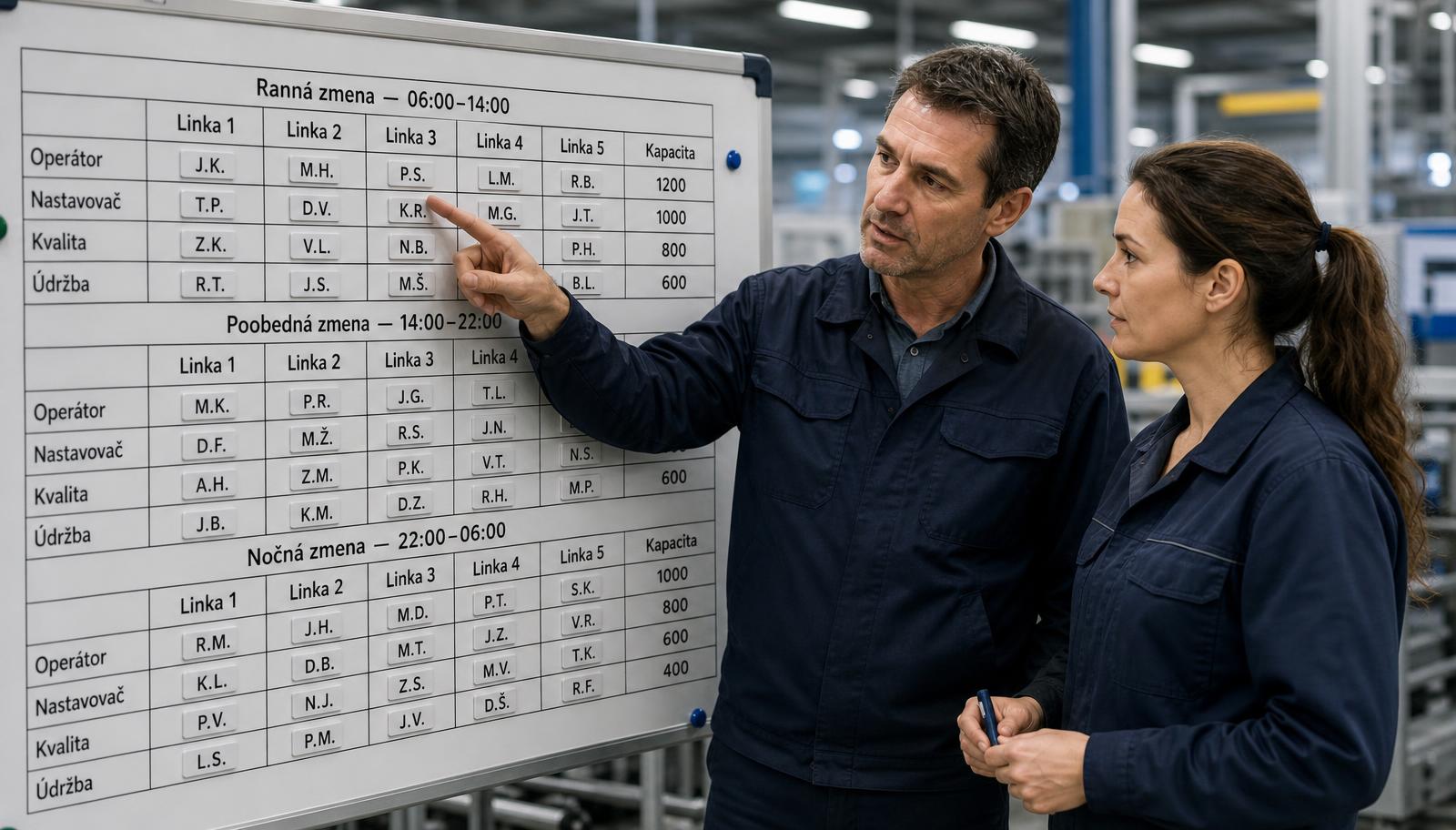
When a plan on paper is not enough
A production plan can be prepared down to the last detail. Orders are distributed between lines, workstations have people assigned to them and the number of workers on each shift matches the planned capacity. Then reality arrives.
In the morning two operators do not turn up. Another worker did come in, but does not have the training or authorisation for the workstation where the gap appeared. An experienced person has to be moved from another line and, within a few minutes, the shift supervisor reworks a division of labour that looked problem-free the evening before.
It is exactly in situations like these that the difference between a shift schedule and genuine production capacity planning becomes visible. A good plan is not one that works only when every employee comes to work and nothing unexpected happens. A good plan must also allow for reality being different from the plan.
The goal of planning is therefore not to create a perfect-looking table. The goal is to make sure production can continue safely, with quality and with as little improvisation as possible, even when the available capacity changes during the day.
Why is shift planning in manufacturing harder than it looks?
At first glance shift planning can seem simple: the company knows the number of workers, the working time and the required output. In practice, however, it is not enough to know only how many people will come to a shift. It is equally important to know what those people are able to do.
Two shifts with the same number of workers need not have the same production capacity. One may have enough experienced operators, setters or workers with the required authorisations. The other may have the same number of people, but lack anyone able to cover a critical workstation. The headcount alone therefore does not tell you whether a shift is ready to meet the production plan.
Plan competencies, not just headcount
One of the most common mistakes is planning by total headcount without a sufficient view of competencies. If ten people are to be on the line, seeing the number ten in the schedule is not enough. The shift supervisor needs to know whether those people include workers able to operate the individual workstations, carry out the necessary setups and cover for colleagues in the event of an outage.
The practical foundation is an up-to-date competency matrix. It should not be a document that is updated only before an audit. It should be a working tool that makes clear who is trained for which position, where they need supervision and which workstations depend on one or two specific people.
Spread experienced workers across the shifts
If most of the most experienced workers are concentrated on one shift, the other shifts can be vulnerable. The problem often does not show up during an ordinary day, but only in the case of an absence, holiday or an unplanned transfer of a worker.
When planning it is therefore worth monitoring not only the number of people, but also the distribution of experience. Every shift should have a reasonable degree of independence and the ability to handle common outages without having to call in a worker from another shift every time.
Interchangeability is not a luxury reserve
Interchangeability is sometimes perceived as surplus capacity. In reality it is one of the most important safeguards of production stability. If a critical operation depends on a single person, the company has not created a saving. It has created an operational risk.
Cross-training workers on several workstations makes it possible to react to absences, holidays and changes in the production programme. It does not have to mean that every worker masters everything. What matters is identifying the workstations whose outage can stop or significantly limit production, and securing genuine interchangeability for them.
Do not plan a shift at the limit of its capability
If every shift is planned to exactly the minimum number of people needed to meet the production plan, even a small outage creates a problem. Such a plan may be efficient on paper, but in everyday operation it is very fragile.
A reserve does not have to mean that the company will keep a large number of people without work. It can take the form of interchangeable workers, a flexible distribution of capacity, a procedure agreed in advance for absences, or a partner able to help top up the team in the case of a larger outage.
Planning reserve capacity and the role of an external partner
Not every manufacturing company has the economic room to build its own staffing reserve. At the same time it may have operations where even a few missing workers significantly complicate meeting the plan.
In such a case a reliable external partner can also be part of capacity planning. Their role should not consist only of starting a hurried search for people once a problem has arisen. Greater value comes from a partner who knows the operation and the required profiles, and who can help stabilise capacity before an outage turns into an everyday crisis.
At FLEXIVIO we work with manufacturing companies on building stable production teams and flexible staffing capacity. External support does not replace good internal planning. It should complement it where the company's own capacity is not enough or where a temporary or unexpected increase in the need for workers has to be handled.
Unreported absences must be part of planning
An unreported absence is not only an attendance problem. For production it is an immediate change in available capacity. If absences are dealt with only after the shift has started, without a procedure prepared in advance, the shift supervisor is left to improvise.
The company should therefore know which workstations are most vulnerable in the event of an absence, who is able to cover them and what the procedure is when one, two or more workers are missing. This is not about creating a scenario for every possibility. It is about making sure the basic decisions do not have to be made from scratch every morning.
Unreported absences in manufacturingUnreported absences in manufacturing: How they affect the production plan and what a company can do5 min readOvertime cannot be the standard answer to a capacity shortage
Overtime is a legitimate tool for handling a short-term need. The problem arises when it becomes a permanent part of planning. If the production plan relies over the long term on the same reliable workers making up the missing capacity through overtime, the company is merely postponing the problem into the future.
Long-term overloading of the most reliable people can lead to fatigue, rising absence and ultimately to departures. A plan that saves production today with overtime may create an even greater shortage of workers a few months later.
Why do people leave manufacturing?Why Do People Leave Manufacturing? 5 Most Common Reasons Management Does Not See7 min readFrom practice
The biggest difference between a well and a poorly prepared shift often cannot be seen on the day when everything works. It becomes visible only when someone does not turn up, a production priority changes or a technical problem appears.
If the shift supervisor knows the competencies of their team, has interchangeability available and knows which workstations are critical, they are able to decide quickly and with less risk. Without that information, every change to the plan means a series of phone calls, transfers and improvised decisions.
Good shift planning is not recognised by how the schedule looks when everyone comes to work. It is recognised by how well production runs once the original plan starts to change.
What is the role of the shift supervisor?
The shift supervisor is a key source of information for planning. They see the real performance of workers, know their strengths, know who can cover for a colleague and which workstations are the most sensitive in the event of an outage.
If planning is done without their feedback, it may be formally correct but operationally weak. Conversely, involving shift supervisors regularly helps uncover problems before they show up as downtime or an unmet plan.
Data worth monitoring when planning
Improving planning does not require starting with dozens of indicators. It is more important to regularly monitor a few pieces of data that are directly useful for decision-making.
- the planned and actual number of workers on a shift,
- absences by workstation and shift,
- the number of and reasons for worker transfers between workstations,
- overtime and its repetition in the same teams,
- critical workstations without sufficient interchangeability,
- worker competencies and how current their training is.
Data alone will not solve the problem. Its value arises only when it is used to adjust planning. If, for example, the same shift regularly ends in overtime or the same workstation repeatedly has no replacement, this is no longer chance. It is information that the plan needs to change.
What you can do today
To improve shift planning you do not have to introduce a new system immediately. Start by checking how resilient your current plan is.
- Choose three critical workstations and verify how many people can fully cover them today.
- Look at the last four weeks and find out which shifts generated the most unplanned overtime.
- Compare the planned number of workers with actual attendance and watch for recurring differences.
- Ask the shift supervisors which outages are the hardest for them to cover.
- Check whether experienced workers are spread across the shifts or concentrated in only some teams.
- Define a simple procedure for the situation when one, two or more workers do not turn up for a shift.
These questions alone often show whether a company is really planning capacity or merely creating a worker schedule.
Conclusion
Shift planning in manufacturing is not just an administrative task. It is one of the basic tools with which a company protects the continuity of production, the productivity of its teams and its ability to meet deadlines.
A good plan allows for competencies, interchangeability, absences and the fact that an unexpected situation may arise during a shift. It does not remove every problem, but it gives the shift supervisor room to deal with them without unnecessary chaos.
The best plan is not the one that works only on an ideal day. It is the plan that remains usable even when conditions in production change.
What we recommend reading next
Unreported absences in manufacturing: How they affect the production plan and what a company can doUnreported absences in manufacturing: How they affect the production plan and what a company can do5 min readWhy do people leave manufacturing? The 5 most common reasons management does not seeWhy Do People Leave Manufacturing? 5 Most Common Reasons Management Does Not See7 min readOnboarding in manufacturing: Why the first days decide whether a new employee staysOnboarding in Manufacturing: Why the First Days Decide Whether a New Employee Stays6 min readHow much does employee turnover cost?How Much Does Employee Turnover Cost? Most Companies Underestimate the Real Cost9 min readQuestions about this topic? See the Knowledge Centre FAQ.
Related topics
- Shift planning
- Workforce planning
- Workforce management
- Manufacturing productivity
- Operational excellence