
Why a new worker does not reach the expected performance: the problem may not be the person
The number shows that performance is lagging. Good management needs to find out why.
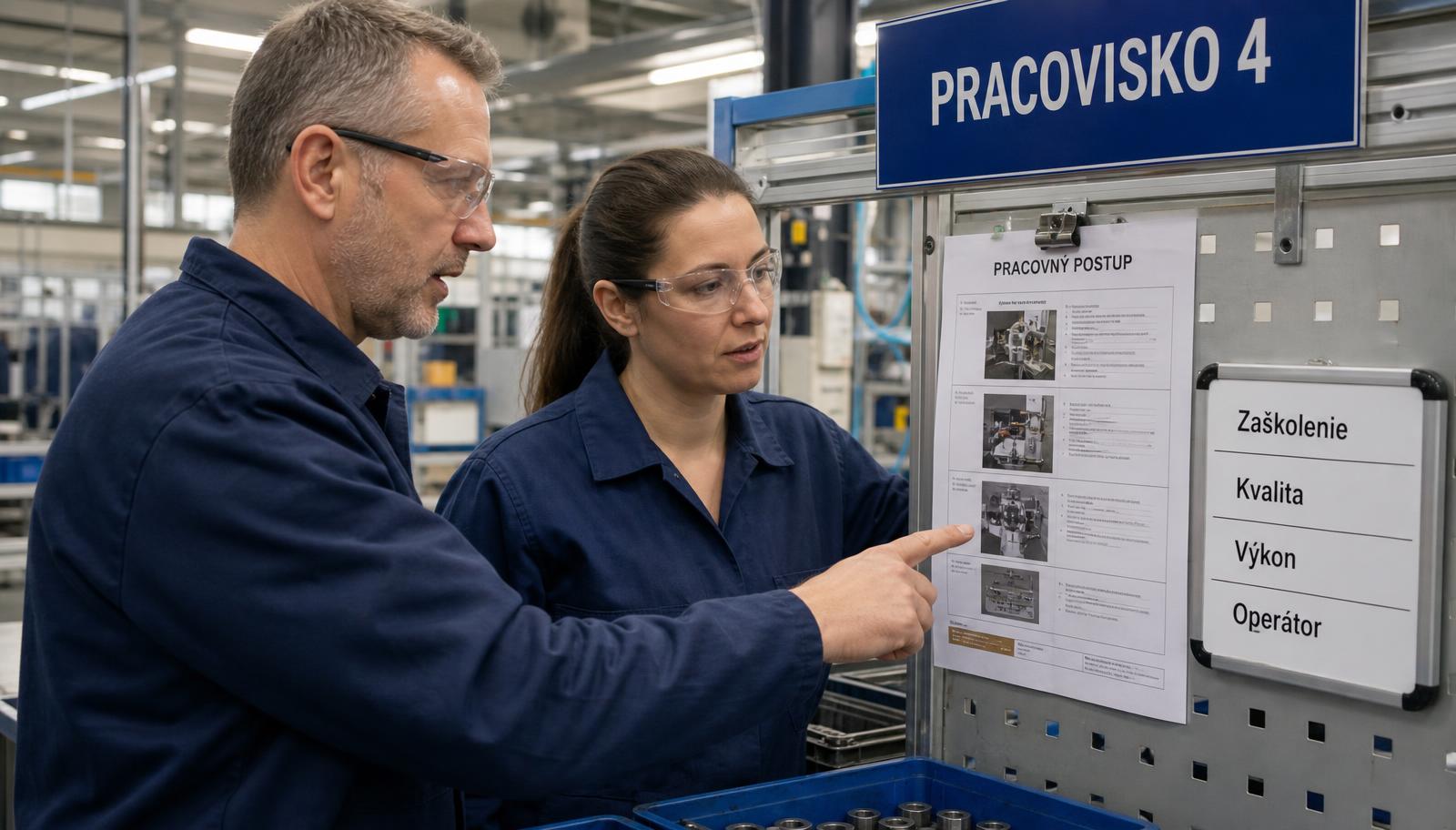
When the numbers show the problem before the cause
A new worker is in their third week. Attendance is fine, they are trying, yet their output still lags behind experienced colleagues. At the morning meeting a simple verdict appears: they are not meeting the standard.
That conclusion may be correct. It may also be far too quick. A number shows the result, not the reason it came about.
A new person may work more slowly simply because they lack practice. But the problem may equally lie in the way they were trained, an unclear work standard, conflicting instructions from colleagues, a poorly prepared workstation, or the expectation that after a few days they will work at the same pace as someone with several years of experience.
If a company automatically labels low output as the worker's problem, it may lose a person who, with the right guidance, would be a stable member of the team a few weeks later.
A new worker and an experienced operator do not start from the same position
An experienced worker already knows the rhythm of the work, the material, the tools and the small situations that the work instruction may not describe in detail. They know where delays arise, how to prepare the workstation and what to do when the process does not follow the ideal scenario.
A new worker does not have that experience yet. Every step has to be checked consciously and every uncertainty has to be asked about. It is therefore natural that during adaptation their output may not match that of an experienced colleague.
What matters is whether their performance is gradually improving. Development over time often says more than comparing a single day against the production standard.
Five areas to check before calling someone underperforming
1. Do they know exactly what is expected of them?
A worker can know their operation and still be unclear about what the company considers good performance. If they do not know the requirements for quality, pace, downtime or the correct work procedure, evaluating their results will always be problematic. Expectations must be specific. Saying they should work faster is not enough. They need to know what to improve and what correctly performed work looks like.
2. Was the training systematic?
In manufacturing, training usually happens alongside normal operations. An experienced operator is given a new colleague while still having to meet their own plan. When production comes under pressure, line output naturally takes priority. The result can be training where the new person knows the basics but is missing the details needed for independent, smooth work. Formally they are trained; practically they are not yet ready for the expected performance.
3. Do they get the same instructions from everyone?
If several colleagues train one worker without a common standard, each of them may demonstrate the work slightly differently. One recommends one method, another a different one, and the shift supervisor then expects a third. The new worker is not losing time because they do not want to work. They lose it trying to work out which way is actually correct. A single work standard is therefore not only a quality tool. It also supports faster adaptation and fairer performance evaluation.
4. Is the workstation ready for the required performance?
Not every difference in output comes from the person. Missing aids, poor material layout, frequent waiting or unclear component availability can reduce the output of even an experienced worker. For a new person the impact is even greater, because they have not developed their own shortcuts or the experience to work around the shortcomings of the workstation. Before evaluating the worker it therefore makes sense to observe their workstation throughout the whole operation, not just the final number.
5. Are the expectations set too early?
If an experienced operator reaches the standard after years of practice, it may not be realistic to expect the same result from a new person after a few shifts.
This does not mean lowering requirements. It means setting an adaptation curve and monitoring whether the worker is approaching the required performance within a reasonable time.
That allows the company to distinguish a person who is learning and progressing from a situation where performance does not improve despite support.
Performance without quality is not good performance
Pressure on speed during the first weeks can have an unwanted consequence. The new worker starts focusing on the number of pieces and skipping steps they are not yet confident about.
In the short term the number may look better. But if defects, rework or the need for colleagues to check the work increase, production has in fact gained nothing.
During adaptation, performance therefore has to be monitored together with quality, safety and the degree of independence.
From practical experience
One of the most common mistakes happens when a new worker is compared with the best person at the workstation. An experienced operator knows the process in detail and performs many actions automatically. The new person still has to think about them. If we only see the difference in the result, the new worker may look weak. If we follow their progress from the first week, the picture may be completely different.
The performance of a new worker has to be judged both by the result and by how quickly they are approaching the required result.
What is the role of the shift supervisor?
The shift supervisor sees the new worker in real operations. They can tell whether the person needs more practice, does not understand the procedure, does not have suitable conditions, or is simply not progressing despite support.
Short regular feedback is therefore more effective than an evaluation only at the end of the probation period. If a problem appears in the second week, the company still has enough time to correct it.
Feedback should be specific: what the worker manages, where they lose time, what they need to practise and what progress is expected before the next review.
Interchangeability in manufacturing: why it is dangerous when only one person can run a critical workstationInterchangeability in manufacturing: Why it is dangerous when only one person can run a critical workstation8 min readWhat a reasonable adaptation curve can look like
There is no universal adaptation curve. A worker on a simple repetitive operation learns differently from a setter or someone at a workstation with high quality requirements.
A company can, however, define indicative milestones for a specific position. For example mastering the work procedure, working independently without constant supervision, stable quality and gradually approaching the target performance.
Such milestones also make sense to the worker. They know what they have already mastered and what is expected next.
How to plan production shifts correctly and handle unexpected worker absencesHow to plan shifts in manufacturing correctly and handle unexpected worker outages7 min readWhen can the problem really be the worker?
Not every case of low output is a consequence of the system. Sometimes a worker cannot reach the required level even after adequate training, clear feedback and sufficient time.
That decision is much better founded if the company can first say that the work standard was clear, the training took place, the workstation was prepared and the person was given a specific opportunity to improve.
The evaluation is then no longer based on an impression. It is based on observation and comparable conditions.
What a company can monitor
- the development of performance from the first week,
- quality and the number of defects,
- the worker's degree of independence,
- the need for help from an experienced colleague,
- time spent waiting or looking for material and aids,
- the training steps completed,
- feedback from the shift supervisor and the mentor.
This data does not have to create more administration. Its purpose is to separate a performance problem from a process problem.
The link with onboarding
The performance of a new worker does not begin with the first measurement against the standard. It begins with the way they were hired, trained and introduced to the working environment.
If onboarding ends with signed documents and a short explanation of the workstation, production may later be solving a problem whose cause arose during the very first days.
Good onboarding is therefore not only a tool for reducing turnover. It is also the basis for reaching stable performance faster.
Onboarding in manufacturing: why the first days decide whether a new employee staysOnboarding in Manufacturing: Why the First Days Decide Whether a New Employee Stays6 min readWhy do people leave manufacturing? 5 common reasons management does not seeWhy Do People Leave Manufacturing? 5 Most Common Reasons Management Does Not See7 min readWhat you can do today
Pick one or two new workers and, instead of the result alone, look at their whole adaptation process.
- Do they know exactly what performance and quality you expect?
- Did they receive the same work procedure from everyone who trained them?
- Is their workstation prepared so they do not have to wait or search for aids unnecessarily?
- Can you compare their performance today with their first week?
- Do they receive regular, specific feedback?
- Have you defined when they should manage each step independently?
If you cannot answer some of these questions, the cause of weaker performance may be broader than the worker alone.
Conclusion
Production needs performance. Without it, plans and customer commitments cannot be met. But evaluating performance correctly does not start with the question of who is slow.
It starts with the question of whether the person had a clear standard, quality training, suitable working conditions and reasonable time to adapt.
Only then is it possible to fairly judge whether the problem lies in the system or in the worker.
“The number shows that performance is lagging. Good management needs to find out why.”
Questions about this topic? See the Knowledge Centre FAQ.
Related topics
- New worker performance and ramp-up
- Onboarding
- Workforce management
- Manufacturing productivity
- Employee retention
- Quality management